Inner Magnetospheric Dynamics and Couplings
by Iulia Chifu & Suzy Bingham & Riham Mohamed
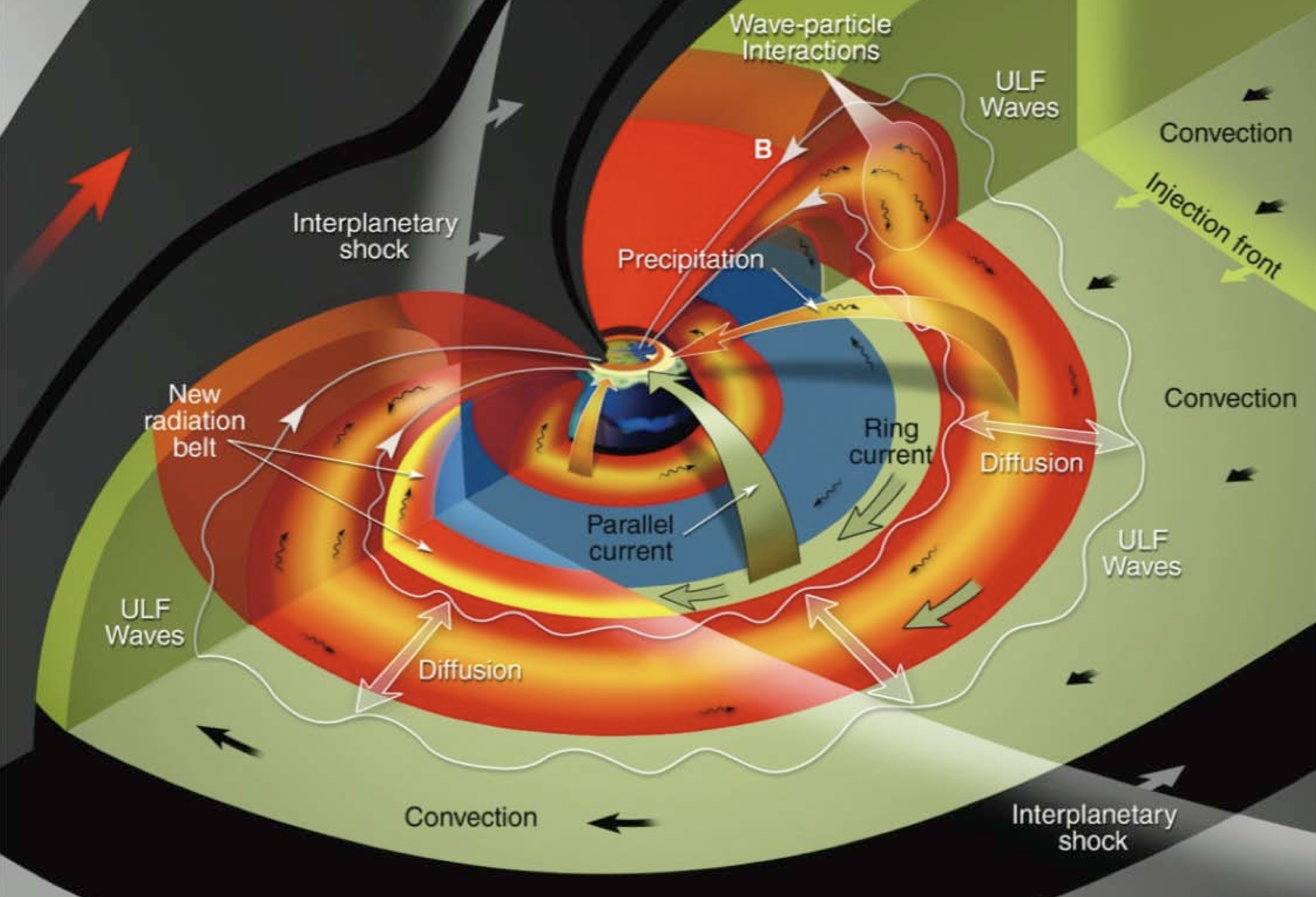
At ESWW 2025, two important sessions will highlight the fundamental physics shaping near-Earth space. Session SWR3 explores the dynamics of the Earth’s inner magnetosphere, focusing on how plasma populations—including the radiation belts and ring current—interact, accelerate, and change through complex processes of transport and loss. The SWR4 session, led by Daria Kotova, Lucilla Alfonsi, Guram Kervalishvili, and Alan Wood, examines the detailed Magnetosphere–Ionosphere–Thermosphere (M-I-T) coupling. The conveners of the SWR3 session, Ravindra Desai, Sarah Glauert, Adnane Osmane, and Alex Lozinski, gather cutting-edge research on the mechanisms behind the energetic environments of the Earth’s inner magnetosphere. The organisers of the SWR4 session emphasise the importance of understanding the interconnected system to effectively predict how space weather phenomena affect our modern, technology-reliant world.
Remaining within the Earth environment, the CD9 session organisers (Lenka Zychova, Christine Verbeke, Laure Lefevre) invite us to a session where the aurora is a radiant thread, connecting the mysteries of space science with the curiosity of its audience.Their session aims to explore how “the aurora is used as a bridge between complex scientific concepts and public understanding”.
One of the SWR3 session scientific highlights is ESA's upcoming Space Weather Missions to the Inner Magnetosphere by Melanie Heil (find the contributed highlight text here). In her poster, she will present the characteristics and status of ESA’s planned D3S missions to the inner magnetosphere, namely SWING, SAWA and SWORD. The SWING mission, scheduled for 2027, is ESA’s first dedicated space weather mission, which focuses on the state of the ionosphere. The SWORD mission composed of two spacecraft, planned for 2031, is dedicated to investigating the radiation belts, and it will include “instruments to cover charged particles from 10 eV to 500 MeV, provide the local magnetic field, Langmuir Probes to determine the electron density in the plasmasphere, and a plasma monitor to provide the thermal electron and ion fluxes”. The SAWA nanosatellite, expected to launch in late 2028, will map magnetic fields, radio wave spectra, and neutral densities in the thermosphere. Melanie Heil’s poster will be available on Thursday, 30.10 at 9:35 AM.
The second scientific highlight of the SWR3 session is the work by Janos Lichtenberger et al. (find the contributed highlight text here), who will present the results of their project Forecast of Actionable Radiation Belt Scenarios (FARBES). The aim is to “provide actionable forecasts for satellite operators on a few key event characteristics: time to the most severe environment; the most severe flux reached; time to the end of the event.” Janos Lichetenberger's poster will be available on Thursday, 30.10 at 9:35 AM.