Space Weather sources, monitoring and forecast
Session SWR1 (Magnetic sources of Space Weather Across Solar Atmospheric Layers, convened by Paolo Pagano, Clementina Sasso, Ioannis Kontogiannis, and Hanna Strecker) brings together contributions about the physical processes occurring in the Sun’s magnetised atmosphere with an impact on Space Weather, either by means of modelling or observations.
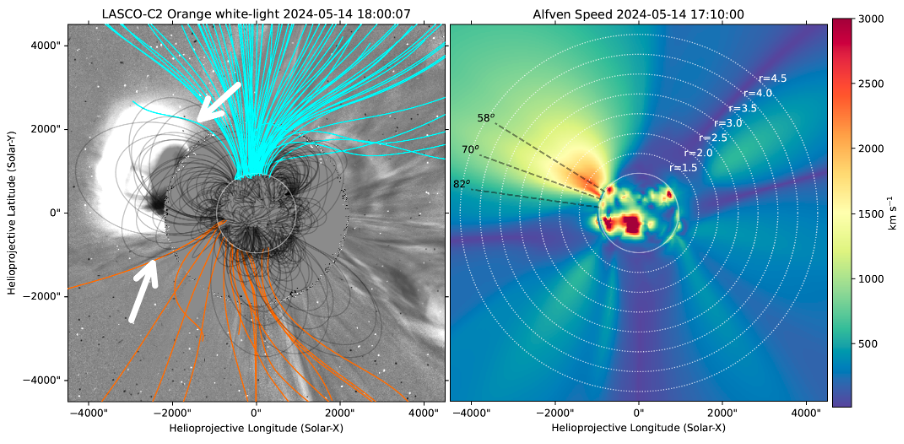 Left: PFSS model on top of the EUV wave in LASCO C2. Right: FORWARD maps showing pre-eruption coronal conditions at 17:10 UT. The white circle denotes the solar limb, the same FOV as LASCO C2 [Nedal et al.]One of the highlights of session SWR1 consists of the development of new strategies for forecasting the occurrence of solar flares based on magnetogram data. Sabrina Guastavino (find the contributed highlight text here) and colleagues discuss the benefits of physics-informed machine learning methods for flare forecasting and also for providing insights into the flare precursors. You can enjoy her talk on this topic on Wednesday, 29.10 at 13:45.
The other highlight of the session combines different types of observations and physical models to investigate the connections between CMEs and type II radio bursts. Mohamed Nedal (find the contributed highlight text here) and colleagues studied the evolution of the fast CME of 14 May 2024, which triggered a sequence of type II bursts at different coronal heights. With the aid of coronal models, coronographic and EUV imagery, they reconstructed the evolution of the CME across the solar corona, and highlighted the need for continuous multi-wavelength solar monitoring and for improved density models. He will present his work on Wednesday, 29.10 at 15:30.
Session CD8 (The Vigil Mission: Advancing Space Weather Operations & Science, convened by Matthew West, Jeffrey Newmark, Steph Yardley and 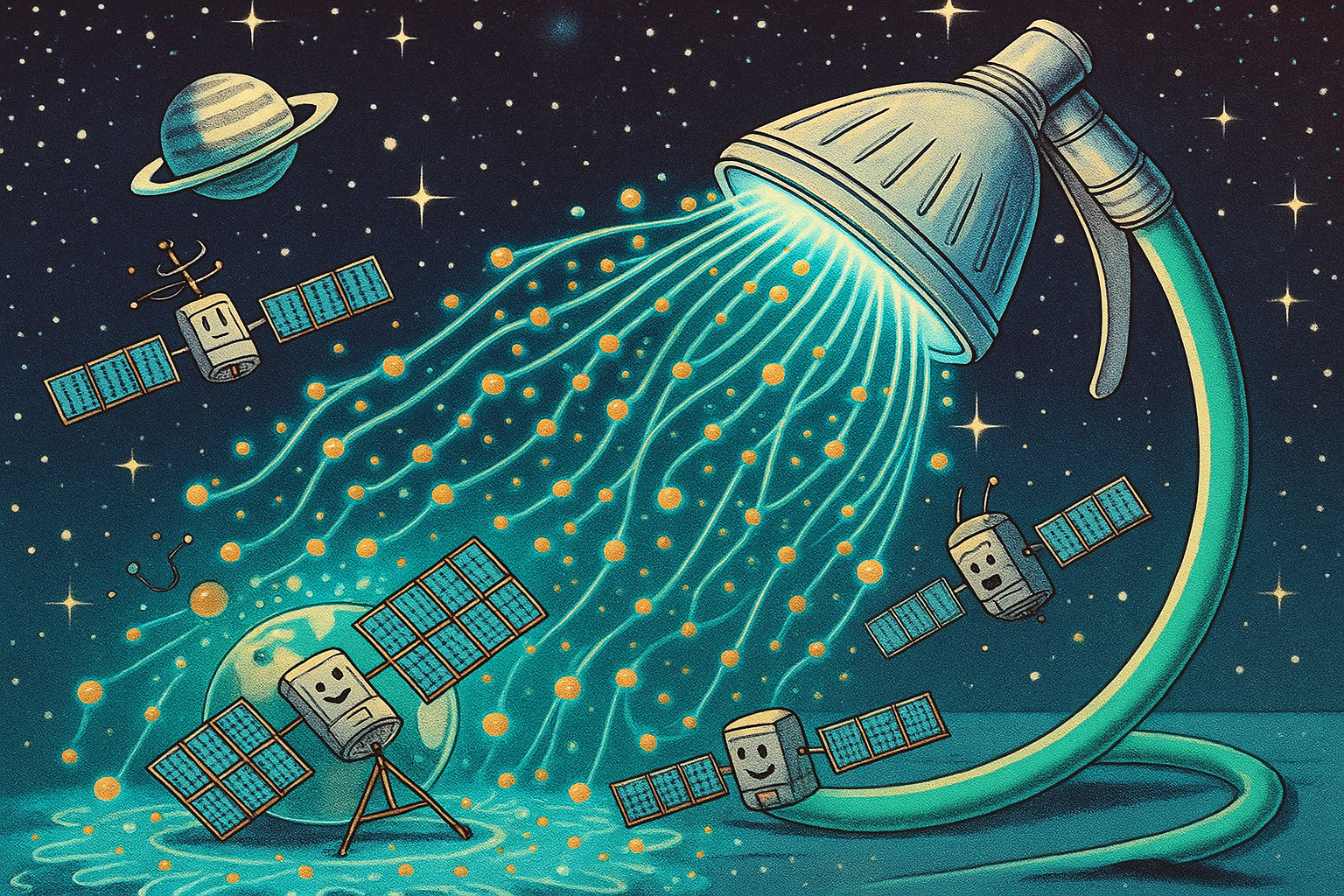 The Sun’s garden hose: how solar winds spray across the Solar System [Podladchikova et al.].Hannah Schunker) aims at engaging with both operational and scientific communities to refine data products, develop new analytical tools, and enhance Vigil’s impact.
The scientific highlight of this session corresponds to the contribution of Tatiana Podladchikova (find the contributed highlight text here)and colleagues, who mapped EUV images of coronal holes to wind speeds within high-speed solar wind streams (HSSs), and quantified the differences that are expected to occur between in situ measurements of the same HSS at L5 and L1. They also conclude about the impacts of the position of the CHs on the wind speeds detected at the same locations. Their results emphasise that including EUV imaging of coronal holes on Vigil will meaningfully improve space weather forecasting, and highlight the scientific and operational value of diverse vantage points in space, such as L5 and L4. She will present her research on Wednesday, 29.10, at 13:45.
Session CD1 (Combination of physics-based and data-driven methods for space weather forecasting, convened by Sabrina Guastavino, Dario del Moro, Filipa S. Barros and Kamen Kozarev) aims at discussing research on data-driven and hybrid approaches to space weather forecasting, combining physics-based and AI methodologies.
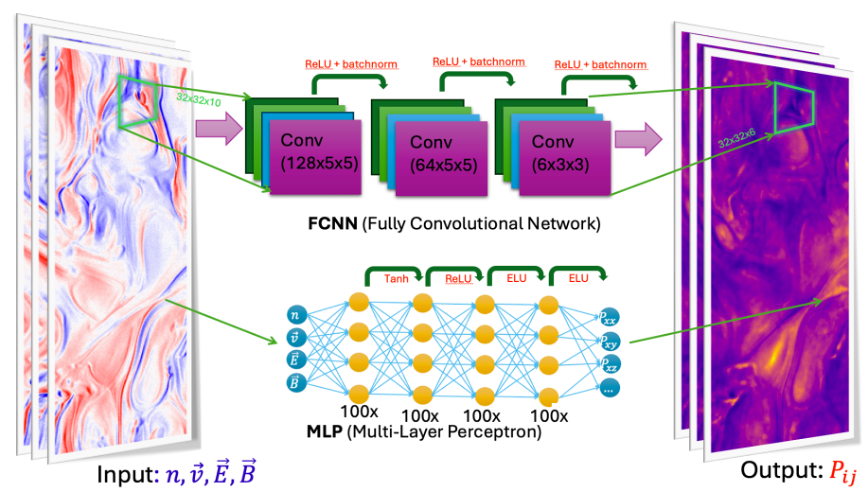 Schematic description of the new hybrid physics–AI framework [Miloshevich et al.].One of the scientific highlights of this session focuses on the coupling between the solar wind and Earth’s magnetosphere. George Miloshevich (find the contributed highlight text here) present a first demonstration of hybrid PIC–AI integration for turbulent magnetosheath plasmas. Their study is based on a new hybrid physics–AI framework that bridges this gap by coupling physics-based kinetic ion models and neural network surrogates for the electron pressure tensor. You will find more on George's research during his talk on Thursday, 30.10 at 10:45 am.
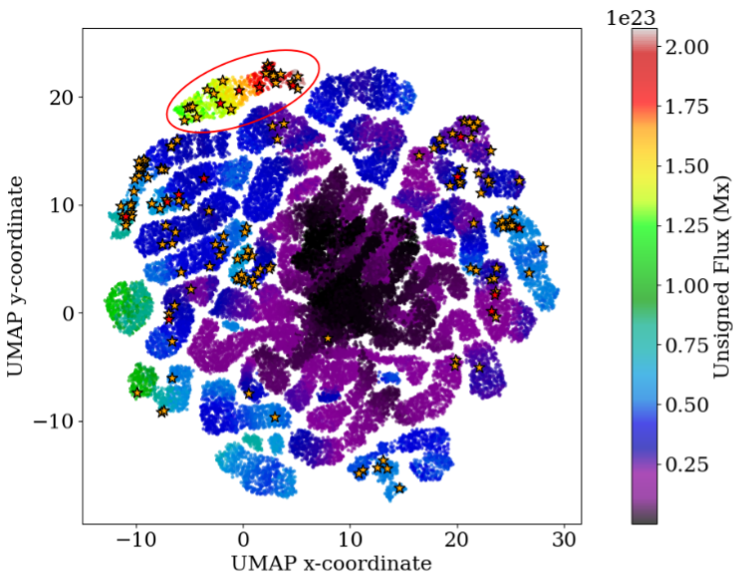 Clusters for individual regions within a SHARP magnetic field map. Flare events are marked with stars [Dineva et al.].The other highlight is brought by Ekaterina Dineva (find the contributed highlight text here), who combines physics-derived and machine-learned features for probabilistic solar flare forecasting. They propose a hybrid strategy that combines the predictive power of SHARP (Space-weather HMI Active Region Patches) parameters with disentangled features learned from SDO/HMI magnetograms using β-VAEs, aiming to leverage the best of both approaches. Their results show that the combined dataset outperforms either SHARP or VAE features alone. The inclusion of machine-learned features reduces false alarms and provides better reliability in probabilistic forecasts. Ekaterina will present her results on Wednesday, 29.10, at 15:00.
Finally, session CD2 (All about the solar wind, convened by Stephan G. Heinemann and Eleanna Asvestari) aims at providing a comprehensive view of current solar wind research, with an emphasis on the sources, acceleration mechanisms and evolution of the solar wind across the corona and heliosphere. Works combining data from recent and long-standing missions, and that provide novel insights on space weather effects and forecasts, will be highlighted.