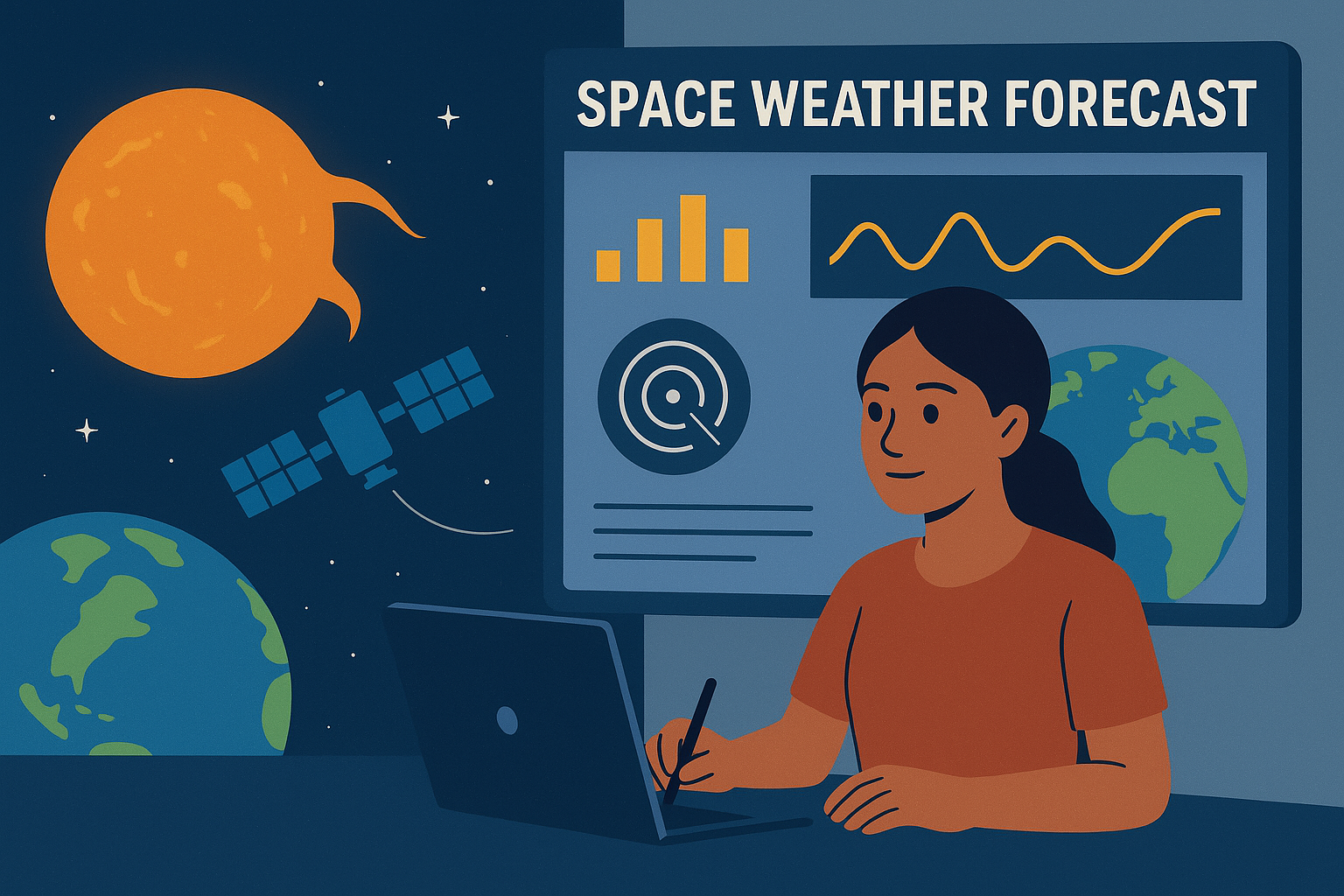
 Connecting Science and Service: Validating Models and Delivering Reliable Space Weather Forecasts
by Iulia Chifu
Conveners Judith de Patoul, Kasper van Dam, Francois-Xavier Bocquet and Mpho Tshisaphung focus their session on the development and delivery of space weather services that support real-world decision-making. The session “Space Weather Services and Alerts for End-Users: Bridging Forecasting, Infrastructure, and Communication” (APL1) has contributions covering topics such as operational forecast of extreme space weather events, new aviation sector services, and the design of systems connecting forecast centers to end-users through improved data delivery, alert mechanisms, and operational resilience-particularly across the aviation, satellites, energy, and GNSS. In Session CD5, “Open Validation in Space Weather Modeling”, conveners Martin Reiss, Barbara Perri, Karin Muglach, and Evangelia Samara tackle a central challenge in forecasting: ensuring model reliability. They emphasise the urgent need for a transparent, community-driven validation framework built on consistent and reproducible standards. Contributions will examine topics such as coronal magnetic field model performance, coronal hole detection, solar wind validation, MHD model benchmarking, and upper atmosphere and radiation belt model assessments. The conveners of the APL2 session have similar questions regarding the reliability of the models, but in their case, it is about flare forecasting models. Shane Maloney, Sophie Murray, Paul Wright, and Anna Massone, conveners of the session “Bridging the Gap: Reproducibility, Deployment, Operation, Updates, and Monitoring of Machine Learning-Based Solar Flare Forecast Models”, revisit the question: Are solar flare forecast models truly reproducible, deployable, and reliable in operation? Their session explores the latest advances in machine learning applications to flare prediction and the ongoing challenge of ensuring these tools are both scientifically sound and operationally ready.