- Exploring Space Climate: Forecasting Solar Activity and Tracing Sunspot History
-
By Iulia Chifu and Rui Pinto
- This year, we welcome back sessions on Space Climate!
- The session Space Climate (SWR5), led by Claudio Corti, will address a wide spectrum of topics related to the physics of space climate. Its central focus is the exploration of opportunities and challenges in understanding and forecasting long-term solar activity and its impacts on the heliosphere and Earth across different timescales. The conveners anticipate engaging discussions on the current state of knowledge concerning sunspot numbers, total and spectral irradiance, open heliospheric flux, radio fluxes, galactic cosmic rays, extreme solar energetic particles, coronal holes, high-speed solar wind streams, coronal mass ejections, geomagnetic activity, geomagnetically induced currents (GICs), magnetic storms, ionospheric parameters, polar vortices, and sudden stratospheric warmings.
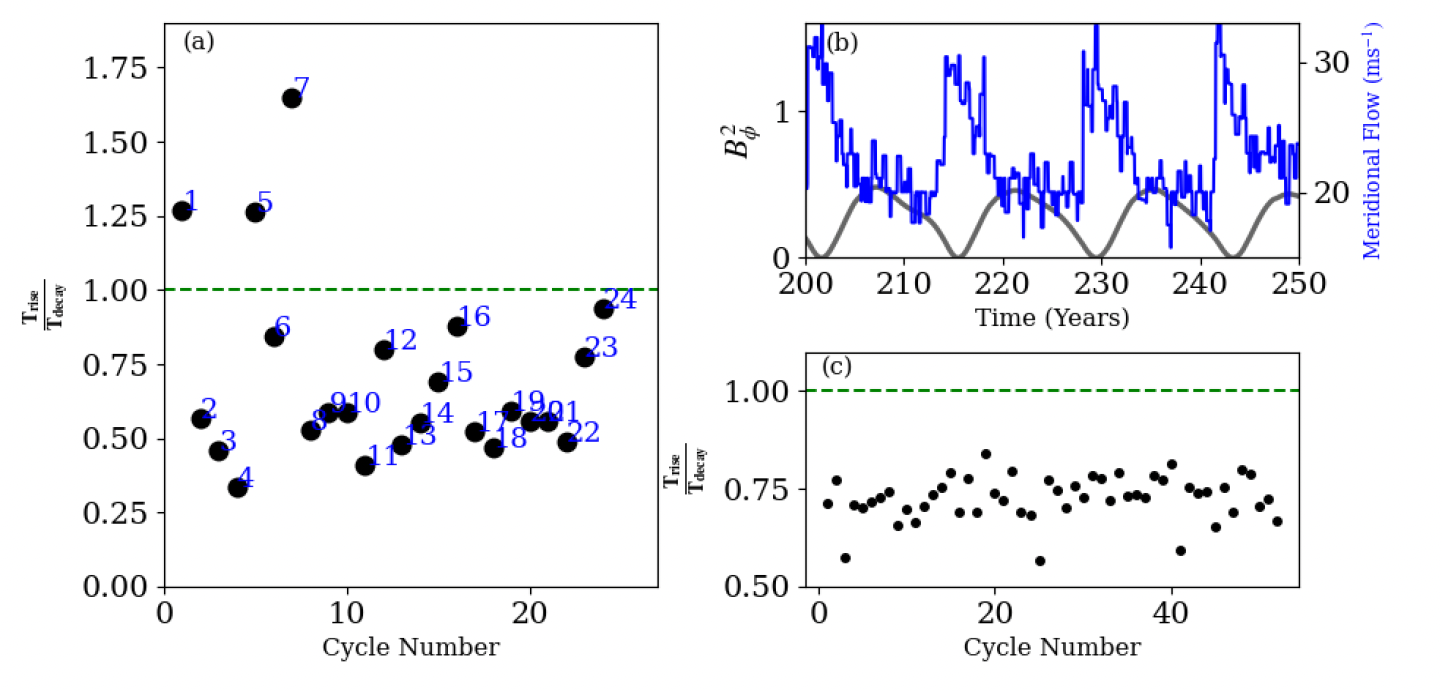 Figure (a): Variation of Trise/Tdecay with the cycle number obtained from the observed sunspot number data. Figure (b), right panel: Simulation results where the meridional flow is modulated by the active region eruption belt [...]. The black curve (right y-axis) shows the evolution of magnetic energy density, while the blue curve (left y-axis) shows the variation in the amplitude of the meridional flow. Figure (c), right panel: Variation of Trise/Tdecay with the cycle number obtained from simulation.[Hazra et al.]Complementing this broad perspective, a more specialised session (CD3) will focus on the sunspot number series. Here, the main convener, Theodosios Chatzistergos, aims to stimulate constructive dialogue on all aspects of historical sunspot observations. Topics will include analyses of sunspot series characteristics, evaluation of cross-calibration methods, recovery and correction of historical records, and comparisons with other solar activity indices. The overarching goal is to strengthen collaborative efforts within the community to improve the accuracy, transparency, and accessibility of sunspot number time series for the scientific community. One of the scientific highlights in Space
 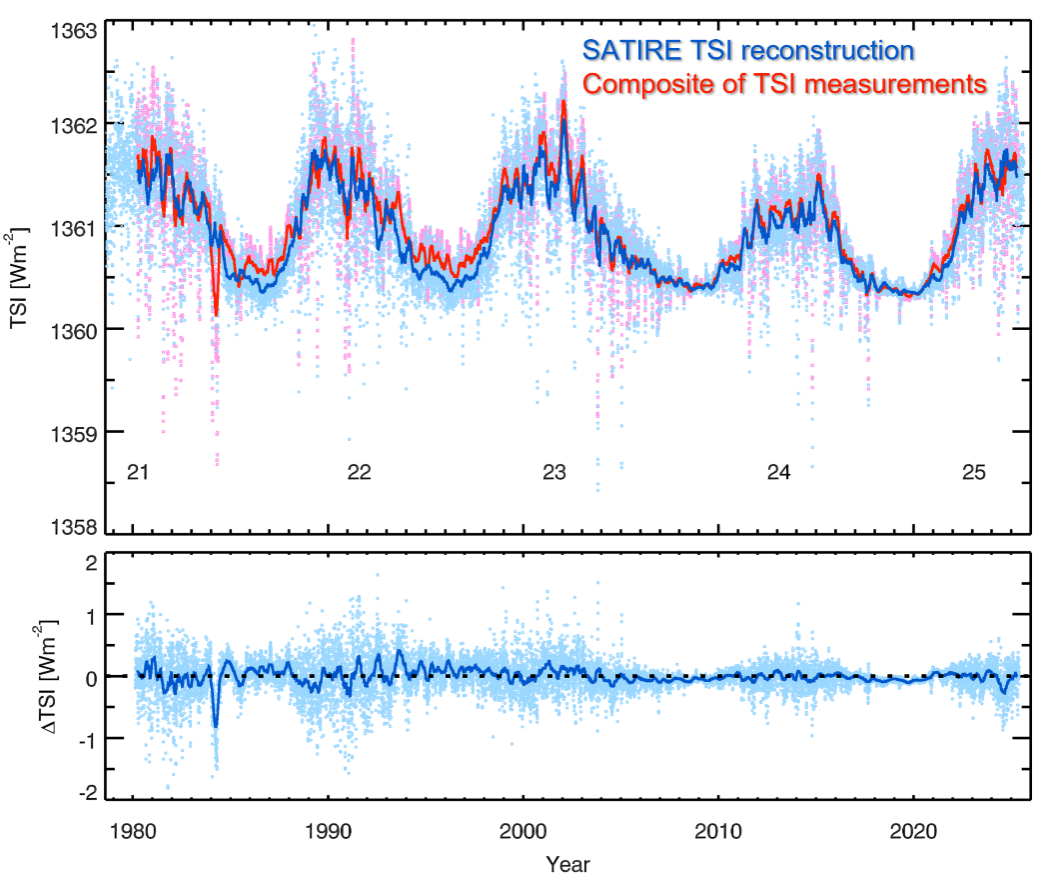 Reconstructed TSI with SATIRE-S by combining all magnetogram sources (top) […] and the difference between our TSI reconstruction and the composite of direct TSI measurements by Montillet et al. 2022; bright and light blue for daily and 81-day running means.[Chatzistergos et al]Climate will focus on whether variations in meridional flow can account for the observed asymmetry between the rising and declining phases of the solar cycle. In this context, Soumitra Hazra (talk on Tuesday, 28.10 at 12:00; contributed highlight text, here) has conducted a series of kinematic flux-transport dynamo simulations to investigate how changes in meridional flow affect the rise–decay asymmetry. Four simulation configurations were tested, and the resulting solar cycles were analysed using key indicators such as the rise-to-decay time ratio and the correlations between cycle amplitude and rise time, rise rate, and early decay rate. The study concludes that “[…] the interplay between systematic magnetic feedback and convective randomness provides a plausible explanation for the observed asymmetry, and […] stronger cycles rise more rapidly”. Turning attention to the solar surface, Theodosios Chatzistergos (online poster; contributed highlight text, here) will present results from the “Solar Irradiance reconstruction with SATIRE,” a semi-empirical, physics-based model. By carefully calibrating long-term ground-based Ca II K observations dating back to 1974, he reconstructed the solar surface magnetic field. These ground-based reconstructions, combined with space-based magnetograms, serve as input for SATIRE-S, which the authors describe as “[…] the most consistent, physics-based solar irradiance reconstruction over the last 50 years”.